Introduction
If you own a diesel vehicle in India — whether it’s a heavy truck plying the highways, a tractor in the fields, or even a passenger car — pay attention. Union Minister Nitin Gadkari has once again stirred the fuel conversation by announcing plans to push isobutanol diesel blending up to 15% in the coming months. The target? Isobutanol blending in diesel India could become reality as early as later this year, with isobutanol diesel blend 2026 already being discussed seriously in policy circles.
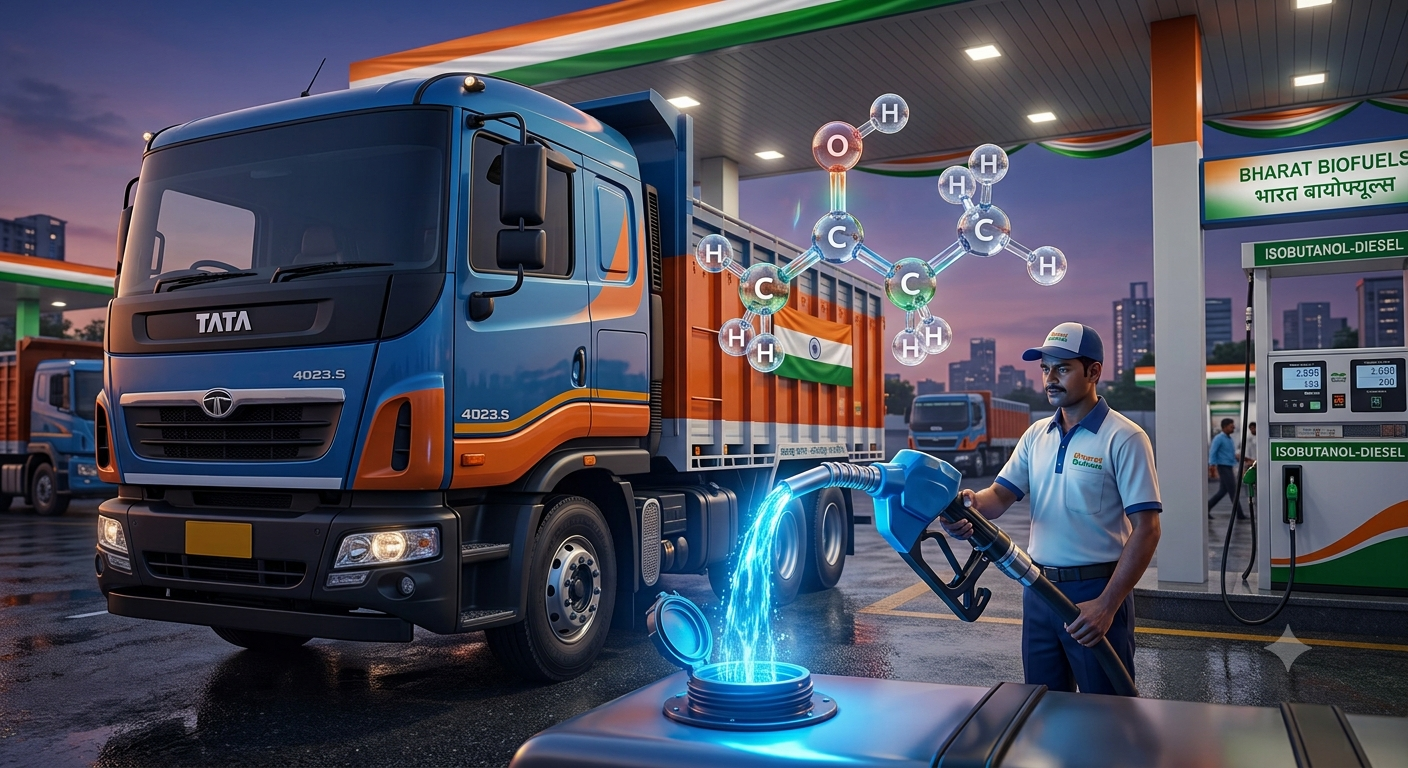
This move comes on the heels of the E20 petrol blending experience, which left many drivers complaining about mileage drops and engine issues. Remember how ethanol-diesel trials largely failed due to poor mixing and stability problems? The government has clearly learned from that and is now betting on isobutanol — a higher alcohol that mixes far better with diesel.
India imports around 85% of its crude oil, and diesel remains the lifeblood of our transport, agriculture, and logistics sectors. With fuel security and rising emission concerns in mind, Gadkari isobutanol announcements are being positioned as a practical step toward reducing dependence on imported fossil fuels while supporting farmers through expanded biofuel production.
But here’s the honest part: while isobutanol in diesel offers real potential for cleaner combustion and energy independence, it’s not without risks. Emerging research highlights non-trivial concerns around engine performance, fuel efficiency, and long-term durability — especially for India’s massive fleet of older BS3 and BS4 vehicles that still dominate our roads.
This isn’t just another biofuel story. It could directly affect millions of diesel owners, fleet operators, mechanics, and even the price at the pump. In the following sections, we’ll dive deep into the science, the policy, the real engine impacts, and what it all means for you on the ground.
Understanding Isobutanol – The Molecule Behind the Policy
So what exactly is this molecule that policymakers are suddenly excited about?
Isobutanol, also known as isobutyl alcohol or by its proper IUPAC name 2-methylpropan-1-ol, is a four-carbon branched primary alcohol with the formula C₄H₁₀O. You can visualise it as (CH₃)₂CHCH₂OH. Unlike its straight-chain cousin n-butanol, the branched structure gives it some unique properties that make it interesting both as an industrial chemical and as a potential fuel component.
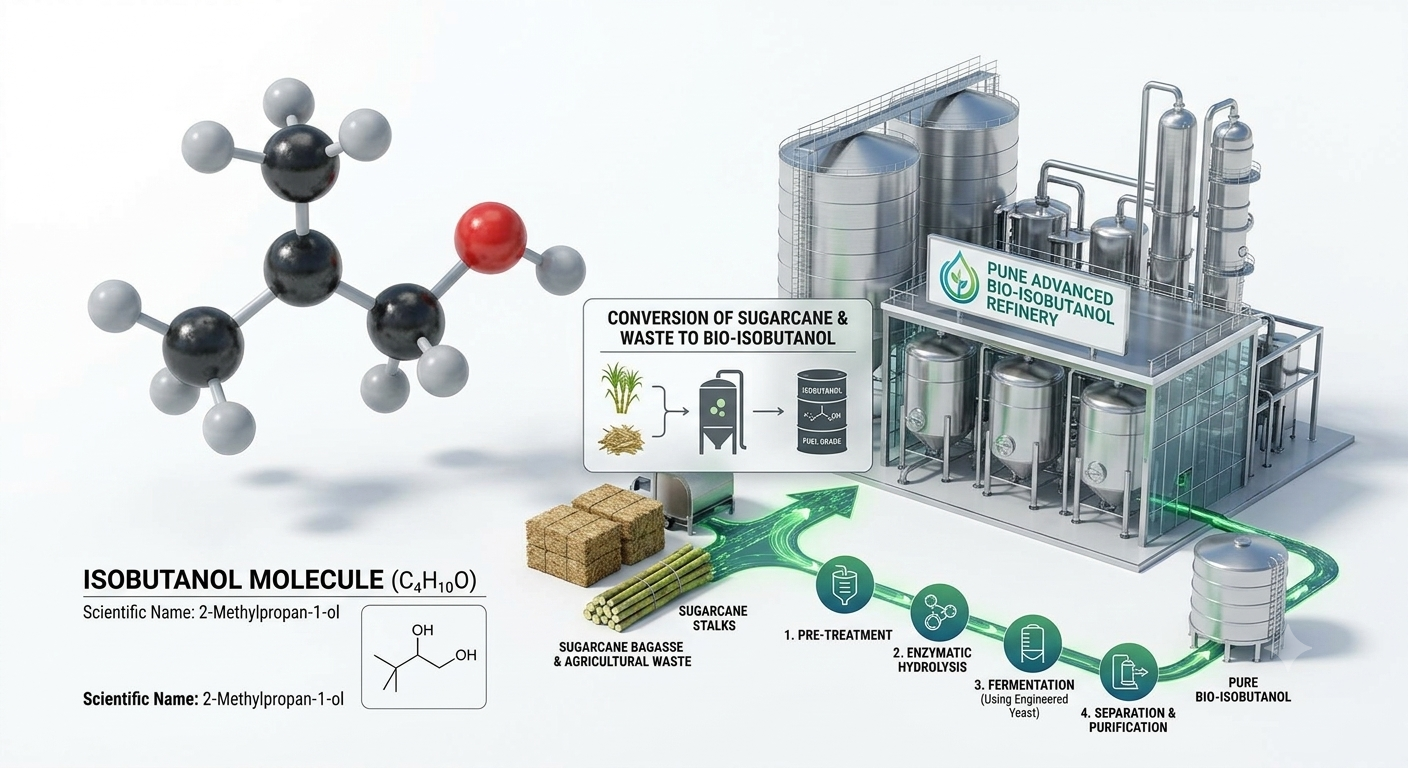
In simple terms, it’s a primary alcohol — the hydroxyl (-OH) group is attached to a carbon that has two hydrogen atoms. This structure allows it to undergo typical alcohol reactions: it can be oxidised to isobutyraldehyde and further to isobutyric acid, it readily forms esters (like the popular isobutyl acetate used in solvents and fragrances), and it can be dehydrated to isobutylene, which is valuable in the petrochemical industry.
Industrially, most isobutanol is still produced through petrochemical routes — mainly via hydroformylation of propylene to isobutyraldehyde, followed by hydrogenation. However, the real excitement in India lies in the bio-isobutanol route. Using engineered microbes and fermentation technology, it can be produced from sugarcane molasses, grains, or agricultural waste — perfectly aligning with our existing ethanol infrastructure and sugar mills.
Now, let’s look at how it stacks up physically and chemically, especially when we talk about isobutanol in diesel applications.
| Property | Isobutanol | Diesel (typical) | Ethanol |
|---|---|---|---|
| Boiling Point | ~108°C | 150–380°C | 78°C |
| Density (20°C) | 0.802 g/cm³ | 0.82–0.85 g/cm³ | 0.79 g/cm³ |
| Energy Content (MJ/kg) | ~33–34 | ~42–44 | ~27 |
| Cetane Number | ~10–20 | 40–55 | Very low |
| Oxygen Content | 21.6% | ~0% | 34.8% |
| Water Solubility | Moderate (~85 g/L) | Very low | Fully miscible |
| Flash Point | ~28–38°C | >55°C | ~13°C |
What makes isobutanol particularly attractive for isobutanol diesel blending is its better balance compared to ethanol. It has higher energy density than ethanol, lower hygroscopicity (it doesn’t attract water as aggressively), and superior miscibility with diesel. These characteristics reduce phase separation risks and corrosion issues that plagued earlier ethanol-diesel experiments. That’s exactly why policymakers are choosing it over pushing ethanol directly into diesel — it’s simply more compatible with existing diesel infrastructure and engines.
Isobutanol vs Traditional Diesel – A Technical Comparison
To really understand what isobutanol in diesel means for engines, we need to look beyond the headlines and compare the two fuels directly. Diesel isn’t a single chemical — it’s a complex mixture of hydrocarbons (mostly C10 to C22 chains) refined from crude oil. Isobutanol, on the other hand, is a single, well-defined molecule. That fundamental difference drives both the opportunities and the challenges in isobutanol vs diesel applications.
Here’s a clear side-by-side comparison of the most important properties:
| Property | Isobutanol | Conventional Diesel | Key Implication |
|---|---|---|---|
| Chemical Nature | Oxygenated alcohol (C₄H₁₀O) | Hydrocarbon mixture | Isobutanol adds oxygen for cleaner burn but lowers energy density |
| Density (20°C) | 0.802 g/cm³ | 0.82–0.85 g/cm³ | Slightly lighter blends |
| Viscosity | ~3.95 cP (20°C) | 2.0–4.5 mm²/s | Comparable – good for injection systems |
| Boiling Point / Range | 108°C | 150–380°C | Much narrower & lower boiling – affects vaporisation |
| Lower Heating Value | ~33–34 MJ/kg | 42–44 MJ/kg | ~23% less energy per kg |
| Cetane Number | ~10–20 | 40–55 | Much poorer ignition quality |
| Oxygen Content | 21.6% | ~0% | Promotes complete combustion, reduces soot |
| Flash Point | 28–38°C | >55°C | More flammable, handling differences |
| Water Miscibility | Moderate (~85 g/L) | Very low | Better isobutanol diesel compatibility than ethanol |
The table makes one thing very clear: isobutanol brings oxygen into the fuel, which is excellent for reducing soot, but it comes at the cost of lower energy content and significantly lower cetane number. This is why isobutanol diesel compatibility is better than ethanol’s, yet still not perfect.
The higher oxygen content helps the fuel burn more completely, which is one of the main reasons researchers see big drops in particulate matter. On the flip side, the lower cetane number and higher latent heat of vaporisation (it takes more energy to evaporate) create noticeable changes in how the fuel ignites and burns inside the combustion chamber.
For Indian conditions — where we have everything from brand-new BS6 tractors to decades-old trucks — these differences matter a lot. Low blends (5-10%) usually stay within acceptable limits for most engines. Higher blends start pushing the boundaries of what current hardware was designed for.
In short, isobutanol isn’t a perfect replacement for diesel, but it’s a much more practical blending agent than many alternatives. The real question is how these property differences translate into actual engine behaviour — which brings us to combustion.
How Isobutanol Changes Diesel Combustion
When you start adding isobutanol to diesel, the combustion process inside the engine changes in several important ways. This is where the isobutanol diesel engine impact becomes most visible — and where many of the benefits and problems originate.
The two biggest factors are lower cetane number and higher latent heat of vaporisation. Diesel engines rely on compression ignition — the fuel auto-ignites when injected into hot compressed air. Isobutanol’s low cetane (roughly 10–20 compared to diesel’s 40–55) means it takes longer to ignite. This is called increased ignition delay.
At the same time, isobutanol absorbs more heat when it evaporates (higher latent heat), which cools the air-fuel mixture slightly. The combined effect is that the fuel has more time to mix with air before combustion starts. This leads to a larger premixed combustion phase, which can produce sharper heat release rates once ignition finally occurs.
In practical terms, studies show:
- Cylinder pressure often rises more sharply after the delay period.
- Peak heat release rate can increase, especially at medium to high loads.
- Combustion duration tends to shorten once burning begins because the better mixing and oxygen content help the fuel burn faster.
These changes have a direct isobutanol diesel engine impact. The longer ignition delay can cause rougher combustion noise, particularly in older engines not calibrated for it. On modern common-rail engines, it may require adjustments to injection timing or EGR rates to keep everything smooth.
Compared to other alcohols, isobutanol sits in a middle ground. Ethanol has an even lower cetane and higher cooling effect, making it much harder to use in diesel. n-Butanol (straight chain) tends to have slightly better ignition qualities than the branched isobutanol. This is why isobutanol diesel blending is considered more practical than ethanol but still needs careful handling.
Real engine tests (including those using exhaust gas recirculation) show that these combustion changes can be managed at lower blend ratios. However, as the percentage of isobutanol increases beyond 15–20%, the ignition delay becomes more pronounced, and the engine may need recalibration to avoid efficiency losses or excessive noise and vibration.
For Indian fleet operators running high annual kilometres, understanding these combustion shifts is crucial. A small change in ignition behaviour might be unnoticeable in city driving but could affect long-haul efficiency and component wear over time.
The next sections will explore exactly how these combustion changes affect performance, emissions, and long-term engine health.
Performance Impacts – The Good, the Bad, and the Trade-offs
When engineers and researchers test isobutanol in diesel, one question always comes up first: how does the engine actually perform? The answer, based on multiple studies, is nuanced — there are some genuine positives, but the negatives are hard to ignore, especially for Indian operators who care deeply about fuel economy and reliability.
On the positive side, the oxygen content in isobutanol can improve combustion completeness in certain conditions. Several experiments have recorded modest gains in brake thermal efficiency (BTE). For example, the well-known 2009 study by Karabektas and Hosoz found that a 10% isobutanol blend actually delivered a slight improvement in BTE at higher engine speeds. The reasoning makes sense: better mixing and oxygen availability help the fuel burn more effectively once ignition occurs.
However, the negatives tend to dominate when you look at overall real-world performance. The most consistent finding across studies is higher brake specific fuel consumption (BSFC). Because isobutanol has roughly 23% lower energy content per kilogram than regular diesel, the engine needs to burn more fuel to produce the same amount of work. This directly translates into reduced isobutanol diesel mileage — something Indian truck drivers and fleet owners are particularly worried about after their experience with E20 petrol.
Power output also takes a hit. In the same Karabektas study, brake power dropped slightly with blends up to 10%, and the decline became more significant at 15–20% blends. An earlier study by Al-Hasan and Al-Momany (2008) on 10–40% blends reported similar trends: lower brake power, reduced exhaust gas temperatures, and noticeably higher fuel consumption.
The isobutanol diesel engine impact here is straightforward. The lower volumetric energy density means you’re effectively putting less energy into the combustion chamber with every injection. While the engine management system in modern BS6 vehicles can compensate to some extent, older mechanical injection systems common in many Indian vehicles have less flexibility.
Real-world implications are significant. For long-haul operators running high annual mileage, even a 5–8% drop in mileage can add up to substantial extra costs. On the other hand, some studies note that at certain load-speed combinations (particularly higher speeds), the improved combustion can partially offset the energy deficit, leading to BTE numbers that are close to, or occasionally better than, pure diesel.
Overall, the performance picture is one of trade-offs. Low blends (5–10%) are generally manageable with only minor penalties. Higher blends push the limits and will likely require engine recalibration, additives, or acceptance of reduced range. For India’s diverse fleet — from shiny new BS6 trucks to older workhorses — this variability is exactly why careful, phased implementation and extensive local testing are so important.
Emissions – Where Isobutanol Shines (and Where It Doesn’t)
One of the strongest arguments for isobutanol diesel blending is its potential to clean up exhaust emissions. However, the reality is more complex than “cleaner fuel = cleaner emissions.” Different pollutants behave differently, and results vary depending on blend ratio, engine type, and operating conditions.
Where isobutanol really shines is in particulate matter (PM) and soot reduction. Multiple studies consistently show significant drops in smoke opacity and soot emissions — sometimes by 50% or more, and in certain dual-fuel setups, up to 90%. This is largely thanks to the 21.6% oxygen content in the molecule, which helps oxidise soot precursors during combustion. For Indian cities struggling with air quality, this is a major potential benefit.
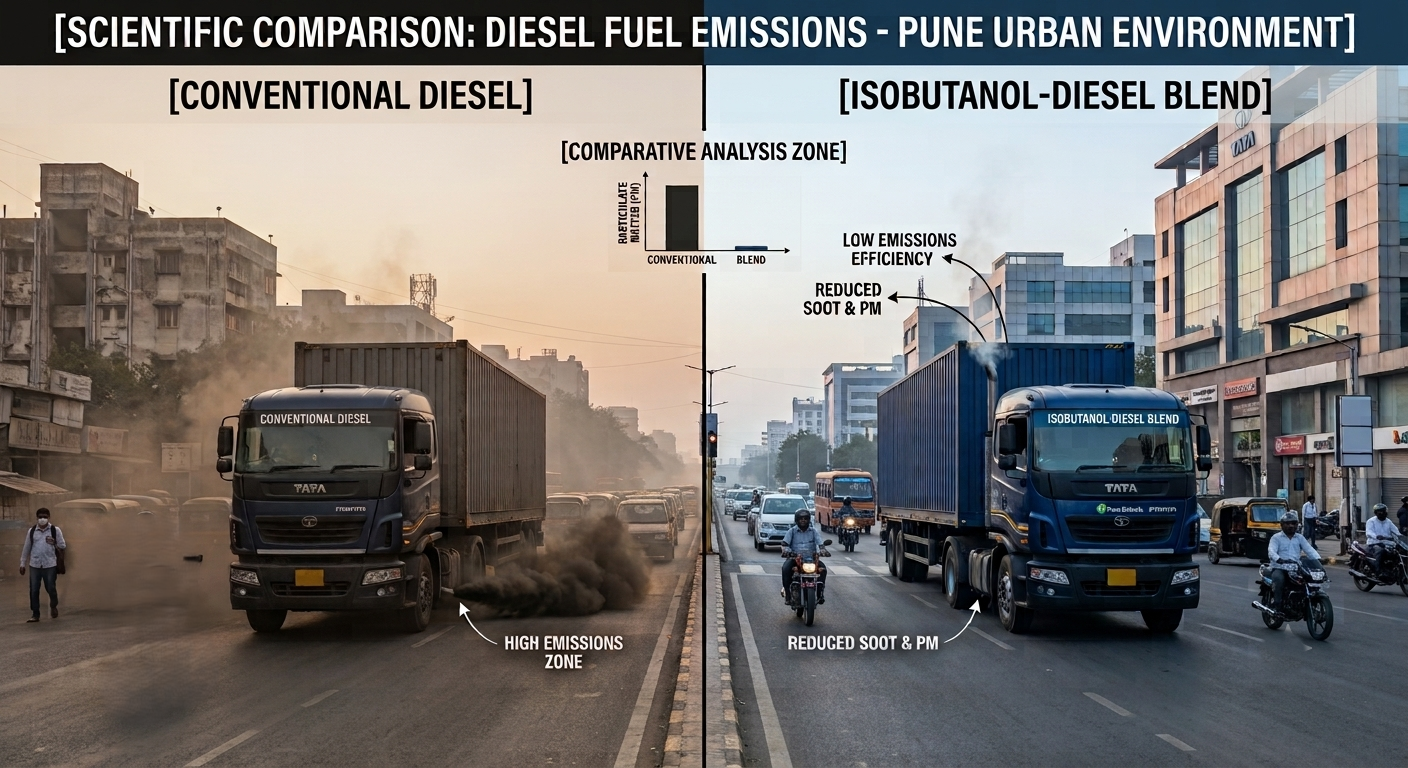
Isobutanol diesel emissions also often show reductions in carbon monoxide (CO), particularly at higher loads, because the extra oxygen promotes more complete combustion.
The picture gets mixed when we look at other pollutants. Hydrocarbons (HC) — basically unburned fuel — tend to increase due to the longer ignition delay, which can lead to some fuel being quenched on cooler cylinder walls. Nitrogen oxides (NOx) are highly variable: many tests show reductions at low-to-medium loads (thanks to the charge cooling effect lowering peak combustion temperatures), but NOx can rise at full load or under certain conditions.
Some studies have also noted increased aldehyde emissions (such as formaldehyde and acetaldehyde), which are common with alcohol fuels. These are not currently regulated as strictly in India, but they deserve attention from a health perspective.
From a broader climate angle, bio-isobutanol offers a meaningful well-to-wheel CO₂ reduction compared to fossil diesel, especially when produced from agricultural waste or surplus sugarcane. This aligns well with India’s climate commitments and biofuel policy goals.
In summary, isobutanol in diesel delivers clear wins on soot and PM — a critical advantage in India’s context. CO reduction is another plus. However, the increases in HC and the inconsistent behaviour of NOx mean that real emission benefits will depend heavily on blend ratio, engine calibration, and aftertreatment systems. Modern BS6 vehicles with DPF and SCR systems are better positioned to handle these trade-offs than older engines.
Negative Impacts on Engines – The Critical Risks
While the potential benefits of isobutanol diesel blending get a lot of attention in policy discussions, any honest assessment must also address the isobutanol diesel engine impact — particularly the risks that could affect performance, reliability, and maintenance costs. This is arguably the most important section for Indian diesel users, as the country has millions of older vehicles and high-mileage commercial fleets.
The most consistent technical issue seen across studies is prolonged ignition delay. Because isobutanol has a much lower cetane number, the fuel takes longer to auto-ignite after injection. This leads to a larger premixed combustion phase, which can cause higher peak cylinder pressures and sharper heat release rates. In practice, this often translates into increased combustion noise, a harsher running feel, and in extreme cases, potential knocking or rough idling — especially in engines not optimised for it.
Fuel system and material compatibility concerns are another serious area. Alcohols like isobutanol can attack certain elastomers, rubber seals, and hoses over time, causing swelling, cracking, or leaks. While isobutanol in diesel is generally better than ethanol in terms of isobutanol diesel compatibility, the risk is not zero — particularly at higher blend ratios and in older fuel systems. There is also potential for corrosion if even small amounts of water are present, as alcohols are more hygroscopic than pure diesel.
Injector and high-pressure pump wear is a growing worry. The changed physical properties of the blend (lower lubricity at higher isobutanol percentages, different viscosity, and altered spray patterns) can lead to poorer atomisation, carbon deposits, and accelerated wear on injectors. This is especially relevant for common-rail systems in modern BS6 diesel engines, where precision is critical.
Aftertreatment systems add another layer of complexity. Diesel particulate filters (DPF) rely on regular regeneration cycles that depend on exhaust temperature and soot loading. The cooler combustion and different exhaust composition from isobutanol blends can delay or complicate regeneration. Similarly, selective catalytic reduction (SCR) efficiency for NOx control may be affected, potentially leading to higher AdBlue consumption or warning lights.
Cold start and low-temperature performance can also suffer. The higher latent heat and lower cetane make it harder for the fuel to ignite when the engine is cold, which could lead to longer cranking times, white smoke, or rough running in winter conditions — a real concern in northern India.
Perhaps most importantly, long-term durability data is still limited. Most published studies are relatively short-duration lab tests on single-cylinder or light-duty engines. We don’t yet have robust, multi-year fleet data for Indian conditions. High-mileage applications — trucks, buses, generators, and older BS3/BS4 vehicles that still form the backbone of our transport and agriculture sectors — face the highest risk. Real-world parallels with E20 petrol (reports of mileage loss, injector issues, and seal degradation) serve as a cautionary tale.
In summary, the isobutanol diesel engine impact is not trivial. While low blends (5–10%) appear manageable for most modern engines, higher percentages could accelerate wear, increase maintenance costs, and reduce reliability for older and heavy-duty applications. This is why extensive local testing by ARAI and careful phased implementation will be crucial.
Studies Supporting Isobutanol in Diesel Engines
The performance and emission effects discussed above are supported by several peer-reviewed studies. Here are some of the most important ones:
| Study | Key Findings |
|---|---|
| Karabektas & Hosoz (2009), Renewable Energy | Tested 5–20% isobutanol blends. Found slight reductions in power, increased fuel consumption, lower CO and NOx emissions, higher HC emissions, and stable fuel blending. |
| Olson et al. (2023), Energies | Comprehensive review of multiple engine studies. Concluded that isobutanol reduces soot and particulate emissions but may increase ignition delay and fuel consumption. |
| Kılınç et al. (2025), PLOS ONE | Demonstrated significant smoke reduction (up to 90%) in dual-fuel diesel operation while maintaining acceptable engine efficiency. |
Overall Research Consensus
Across published studies, researchers generally agree that:
- Low blends (5–10%) require little or no engine modification.
- Soot and particulate matter are consistently reduced.
- Fuel consumption (BSFC) generally increases because isobutanol contains less energy than diesel.
- Ignition delay increases due to its lower cetane number.
- NOx results are mixed and depend on engine design, load, and operating conditions.
- Long-term durability data on commercial vehicles is still limited, especially for heavy-duty fleets and older diesel engines.
India’s Policy Landscape & Implementation Challenges
The push for isobutanol blending in diesel India is gaining serious momentum. In recent months, Union Minister Nitin Gadkari has repeatedly highlighted the government’s intention to introduce up to 15% blending, describing it as a logical next step after the successful E20 petrol programme. The plan for isobutanol diesel blend 2026 is now very much on the table, with expectations of initial mandates possibly starting later this year.
The broader framework comes from the National Policy on Biofuels (2018, amended 2022), which aims to reduce petroleum imports, support rural economies, and cut emissions. Gadkari isobutanol comments have emphasised converting surplus ethanol into isobutanol, leveraging existing sugar mills and biofuel infrastructure. The Automotive Research Association of India (ARAI) is currently conducting tests on blends, while Oil Marketing Companies (OMCs) like BPCL are involved in validation and supply chain preparation.
From an economic and social angle, the policy has clear upsides. It could create new revenue streams for farmers and sugar mills, reduce the massive oil import bill, and generate rural employment in biofuel production. For a country that imports ~85% of its crude, even modest blending percentages could translate into significant foreign exchange savings.
However, implementation challenges are substantial. Consumer costs are a major concern — many fear further drops in isobutanol diesel mileage, which would hit truckers and taxi operators particularly hard. There are also questions around pricing: how will blended diesel be priced compared to regular diesel? Will there be subsidies or cross-subsidisation?
Technical and regulatory safeguards will be essential. These include clear standards for blend quality, mandatory use of additives (cetane improvers, lubricity enhancers, corrosion inhibitors), updated warranties from vehicle manufacturers, and robust monitoring systems. A phased rollout — starting with 5–10% in select regions or fleet segments before scaling nationally — would help manage risks.
The success of isobutanol blending in diesel India will ultimately depend on balancing ambition with pragmatism. If done right, it could strengthen energy security and support cleaner air. If rushed without addressing engine compatibility and consumer concerns, it risks repeating some of the difficulties seen with E20.
The coming months of testing and stakeholder consultation will be critical in shaping how this policy actually lands on the ground.
Practical Advice for Diesel Users in India
As isobutanol diesel blending moves closer to reality in India, here’s what you should actually do if you own or operate diesel vehicles.
What to monitor closely Pay attention to fuel consumption first — many studies show a noticeable impact on isobutanol diesel mileage, especially in the initial weeks after switching to blended fuel. Also watch for changes in engine noise, smoothness of idling, and any new warning lights on modern vehicles. Black smoke reduction is likely, but white smoke during cold starts or unusual exhaust odour should be noted. Keep an eye on fuel filter changes — they may clog faster initially due to deposits.
Questions to ask your workshop or dealer
- Is my vehicle (model/year) compatible with the expected blend percentage?
- Will this affect the warranty, especially for BS6 engines?
- Should I use any specific additives for lubricity or corrosion protection?
- How will cold-weather performance be affected in my region?
Blend ratio concerns Most research suggests low blends (5–10%) are the safest starting point with minimal isobutanol diesel engine impact. Higher blends (above 15%) increase risks significantly. Until official notifications are clear, assume gradual introduction.
Recommendations by vehicle type
- New BS6 cars/SUVs: Likely the least affected due to advanced engine management and aftertreatment. Still, monitor mileage and get a software update if offered by the manufacturer.
- Heavy commercial trucks & buses: Highest risk due to high annual mileage. Fleet operators should negotiate with OMCs for trial data and consider pilot testing on a few vehicles first.
- Older BS3/BS4 vehicles & tractors: Most vulnerable to compatibility and wear issues. Use lower blends if possible and maintain stricter service intervals.
- Generators & stationary engines: Early pilots have shown 100% isobutanol can work, but real-world long-term reliability needs verification.
Bottom line: Don’t panic, but don’t be blindly optimistic either. Stay informed through official ARAI and MoPNG updates, keep good service records, and consider joining owner forums for real-user feedback as blending begins.
Conclusion
Isobutanol diesel blending represents a bold and necessary step in India’s journey toward energy security and lower emissions. On paper, the advantages are clear: better compatibility than ethanol, strong potential for soot reduction, and a way to utilise domestic biofuel resources. For a country that imports the vast majority of its oil, isobutanol blending in diesel India could meaningfully reduce dependence on foreign crude while supporting farmers and rural economies.
Yet the challenges are equally real. Research consistently shows trade-offs — reduced mileage, power loss at higher blends, longer ignition delay, and legitimate concerns about long-term engine durability, particularly for older vehicles and high-mileage fleets. The isobutanol diesel engine impact cannot be ignored if we want this transition to succeed without creating new problems for millions of diesel users.
The coming year will be decisive. We need transparent, India-specific long-term testing, clear communication from manufacturers, and genuine stakeholder consultation — including drivers, fleet operators, mechanics, and independent researchers.
As India moves forward, informed drivers and robust data will be key. The goal should not be speed at all costs, but a thoughtful rollout that actually delivers cleaner air and energy independence without leaving vehicle owners bearing hidden costs.
What are your thoughts? Drop them in the comments — especially if you run a diesel vehicle or fleet. The more real-world voices we hear, the better this transition can be.
Continue Exploring Related Articles
If you found this guide useful, you may also enjoy these in-depth articles:
- Advances in EV Battery Recycling (2026) – Discover the latest technologies making electric vehicle batteries more sustainable.
- Importance of Lubrication – Learn why lubrication is essential, its history, purpose, and the different types used across industries.
- The Skyrider X1 Flying Motorcycle – Explore the futuristic Chinese flying motorcycle that’s pushing personal air mobility into reality.
- History & Evolution of the IC Engine – Explore how the internal combustion engine evolved from early inventions to today’s advanced diesel and petrol engines.
Frequently Asked Questions
What is isobutanol diesel blending?
Isobutanol diesel blending is the process of mixing isobutanol—a four-carbon alcohol biofuel—with conventional diesel. It aims to reduce emissions, improve energy security, and decrease dependence on imported crude oil while requiring minimal changes to existing fuel infrastructure.
Will isobutanol damage diesel engines?
At low blend levels (around 5–10%), most studies suggest isobutanol can be used without major engine modifications. However, higher blends may increase ignition delay, fuel consumption, and long-term wear, especially in older diesel engines. More long-term real-world testing is still needed.
Is isobutanol better than ethanol for diesel engines?
Yes. Isobutanol mixes with diesel much better than ethanol, has a higher energy content, absorbs less water, and is less likely to separate during storage. These properties make it a more practical biofuel for diesel blending.
Will isobutanol reduce diesel mileage?
Potentially yes. Since isobutanol contains about 20–25% less energy than diesel, engines generally consume slightly more fuel to produce the same power. The impact is usually small at low blend percentages but becomes more noticeable as the blend ratio increases.
Does isobutanol reduce diesel emissions?
Research consistently shows lower particulate matter (PM), soot, and often carbon monoxide (CO) emissions. However, hydrocarbon (HC) emissions may increase, while NOx emissions depend on the engine type, operating conditions, and blend ratio.
Is India planning to introduce isobutanol-blended diesel?
Yes. The Indian government has announced plans to explore diesel blending with up to 15% isobutanol as part of its broader biofuel strategy. Before nationwide implementation, the proposed blends are expected to undergo testing and validation by organizations such as ARAI.
Can older BS3 and BS4 diesel vehicles use isobutanol blends?
Low blends may be compatible with many older vehicles, but these engines are generally more susceptible to changes in fuel properties. Owners should follow manufacturer recommendations and monitor official government guidelines before using higher blend percentages.
Why is India promoting isobutanol instead of ethanol for diesel?
Unlike ethanol, isobutanol has better compatibility with diesel, higher energy density, and improved storage stability. These advantages make it a more suitable candidate for diesel blending while supporting India's goals of reducing crude oil imports and expanding biofuel production.