With global EV sales hitting 20.7 million units in 2025 and end-of-life (EOL) lithium-ion batteries exceeding 500,000 tons annually, EV battery recycling technologies has become essential for sustainable mobility. Projections show this waste stream surging toward 7 million tons by 2035, creating both an environmental challenge and a massive opportunity to recover critical minerals like lithium, cobalt, nickel, manganese—and now graphite.
The good news? The past 18 months have delivered breakthroughs in lithium-ion battery recycling efficiency, commercial-scale facilities, and policy support. This updated 2026 guide explores the latest EV battery recycling technologies, market trends, research, commercial wins, regulatory shifts, and India-specific developments—delivering original analysis, quantitative comparisons, and actionable insights for a true circular battery economy.
Why EV Battery Recycling Matters: Supply Chain Security, Economics & Sustainability
Lithium-ion battery recycling isn’t just waste management—it’s strategic resource recovery. Retired EV packs retain 70-80% capacity at EOL. Advanced processes recover 95%+ of high-value metals at 30-50% lower cost than virgin mining. Recent LCAs confirm hydrometallurgy and direct recycling cut greenhouse-gas emissions by up to 50% versus primary production, while second-life applications before recycling can boost profits by 58% and slash emissions by 18%.
Market momentum is strong: the global EV battery recycling market is valued at approximately USD 6.31 billion in 2025 and is forecast to grow at 20-40% CAGR, potentially reaching USD 87+ billion by 2035. In India, the lithium-ion segment alone is projected to hit USD 532 million in 2026 and nearly USD 2 billion by 2034 at 18%+ CAGR, driven by Delhi EV Policy 2.0 and national Battery Waste Management Rules.
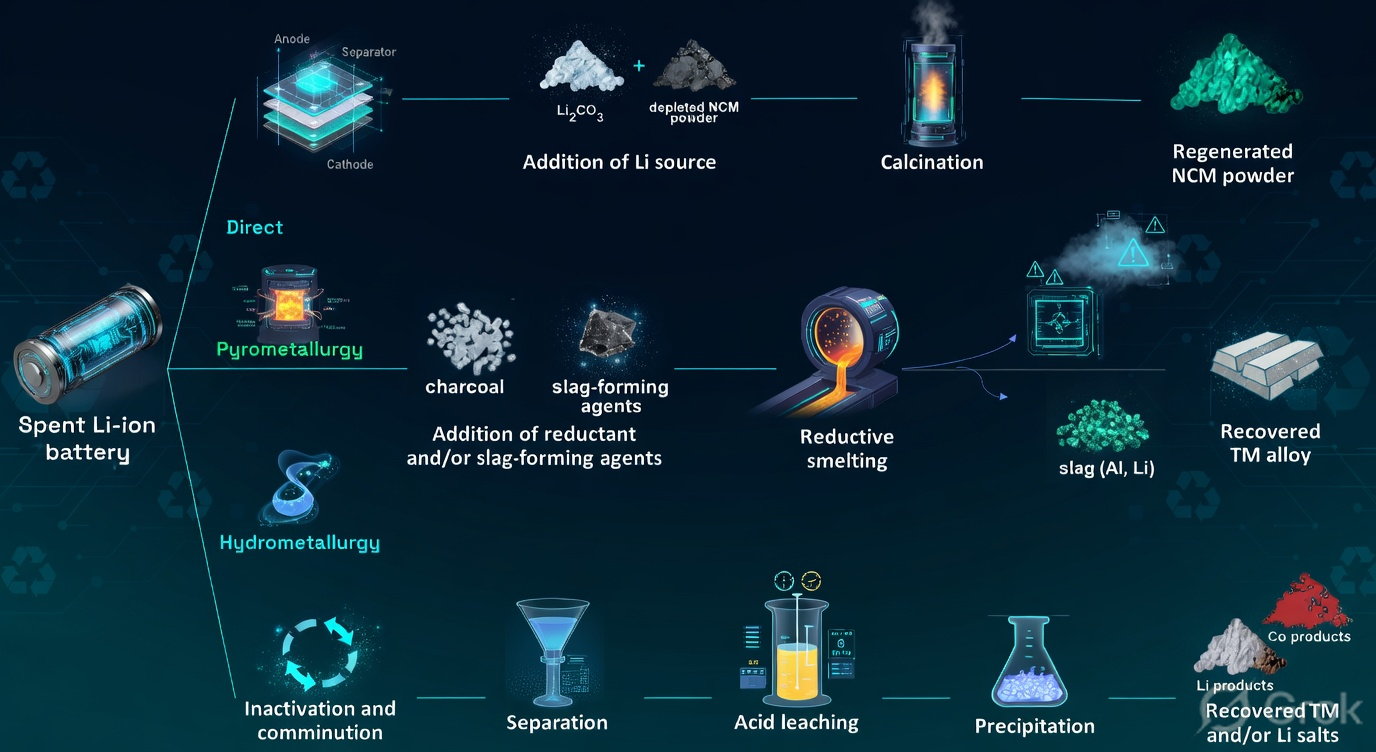
Core Lithium-Ion Battery Recycling Processes: Pyrometallurgy, Hydrometallurgy & Direct Recycling Compared
Three dominant pathways define EV battery recycling technologies today. Each starts with safe disassembly and shredding into “black mass.”
Comparison Table:
| Process | Energy Use & Emissions | Recovery Rates | Pros | Cons | Best For |
|---|---|---|---|---|---|
| Pyrometallurgy (Smelting) | High (high-temp) | 80-95% (Ni/Co); low for Li/Mn | Handles mixed chemistries; mature | High energy/CO₂; loses Li | Mixed feedstocks, high-volume |
| Hydrometallurgy | Medium-low | >95% for Li/Co/Ni/Mn | Battery-grade purity; scalable | Chemical waste; prep needed | High-purity recovery |
| Direct Recycling | Lowest (80-90% savings) | 90-98% functional material | Highest value; minimal waste | Sensitive to chemistry | Homogeneous NMC/LFP streams |
A 2025-2026 systematic review of LCAs confirms direct recycling and hydrometallurgy deliver the lowest GHG footprints. Innovations like ReCell Center’s froth flotation and new hydrothermal relithiation now make direct recycling viable for mixed streams, unlocking higher margins.
Research Breakthroughs Driving EV Battery Recycling Forward
Global capacity must grow 50-fold by 2035. Key 2026 advances include:
- Automated dismantling & AI sorting: DOE-funded robotic systems cut labor costs 40-60%.
- Impurity removal & relithiation: Hydrothermal and solid-state methods enable commercial-scale direct recycling.
- Bioleaching & green solvents: Achieve 99% selectivity for LFP.
- Graphite recovery: Flash Joule heating and flotation now recover high-performance anode material.
- Second-life optimization: Modeling shows 84% collection rates are key; LFP packs excel in stationary storage.
Standardized pack design remains the top bottleneck.
Commercial Leaders & Facility Milestones in EV Battery Recycling
- Mercedes-Benz Kuppenheim (Germany): Europe’s first integrated plant (2024) – 2,500-ton capacity, >96% recovery, net-CO₂-neutral.
- Redwood Materials (USA): Full-scale Carolina campus operational on 100% clean energy, producing cathode/anode from recycled material.
- Ascend Elements & Li-Cycle: Hydro-to-Cathode™ and Rochester Hub advancing.
India Spotlight: Attero Recycling is scaling lithium-ion capacity to 300,000 tons with 98%+ recovery and has won EV Battery Recycling Company of the Year. The company is investing ₹7,000 crore over five years in rare-earth and battery refining (including Telangana plant) and aims for ₹2,000 crore revenue in FY26. Leaders like Lohum (hydrometallurgical + second-life), BatX, and Exigo are expanding modular plants. Delhi EV Policy 2.0 and Battery Waste Management Rules (EPR targets to 90% by 2026-27) position India as Asia-Pacific’s recycling hub.
Regulatory Drivers: EU Battery Passport, US IRA & India’s EPR Push
- EU: 2026 enforcement includes carbon footprint declarations, 90% recovery targets, and digital battery passports.
- US: IRA ties credits to domestic recycled content.
- India: EPR mandates 70%+ collection by 2027-28 and 90% recovery by 2026-27, with new audits.
LFP economics are improving via subsidies and second-life routes.
Challenges, Second-Life Synergies & Emerging Innovations
Hurdles include pack heterogeneity, fire risks, and LFP profitability. Solutions:
- Second-life storage: Repurpose 70-80% SOH packs for grid/telecom ESS—boosting value by 58% and cutting emissions 18%.
- AI/robotics and mobile hubs cut disassembly costs 50%.
- Graphite recovery and solid-state prep target full closed-loop.
Economic & Environmental Impact: Quantifying the Wins
Recycling one ton of EV batteries avoids 2.7-4.6 tons CO₂-equivalent and can generate USD 1,000-4,000+ net profit per ton for NMC under optimized conditions. By 2035, closed-loop systems could create tens of billions in value and thousands of green jobs in India alone.
Future Outlook: A Circular Battery Economy by 2035
Expect 50-fold capacity growth, design-for-recycling standards, digital passports, and hybrid direct + hydrometallurgy plants. In India, domestic capacity could meet 30-50% of critical mineral needs, supporting Aatmanirbhar Bharat.
Every retired EV battery is tomorrow’s cathode. Investing in EV battery recycling technologies today secures supply chains, slashes emissions, and accelerates decarbonization.
FAQs on EV Battery Recycling Technologies 2026
What is the best EV battery recycling process in 2026?
Direct recycling offers the lowest energy use and highest-value output for consistent feedstock; hydrometallurgy remains most scalable for mixed chemistries.
How does second-life EV battery use work?
Packs with 70-80% capacity are repurposed for stationary storage before final recycling—boosting profits up to 58% and cutting emissions 18%.
What are the top EV battery recycling companies in India?
Attero, Lohum, BatX, Exigo, and Ace Green lead with advanced hydrometallurgical and direct recycling processes.
When will India reach 90% battery collection rates?
EPR rules target 70%+ by 2027-28 and 90% material recovery by 2026-27, accelerated by Delhi EV Policy 2.0.
How much does lithium-ion battery recycling reduce CO₂?
Up to 50% lower lifecycle emissions vs. virgin materials; optimized direct recycling avoids 9× more CO₂.
The electric vehicle revolution is no longer just about selling more cars — it’s about closing the loop on the batteries that power them. In 2026, breakthroughs in direct recycling, advanced hydrometallurgy, AI-driven dismantling, and profitable second-life applications have transformed EV battery recycling from an environmental necessity into a high-margin, strategic opportunity.
For India, the timing could not be better. With aggressive EPR targets, Delhi EV Policy 2.0, and homegrown champions like Attero, Lohum, BatX, and Exigo scaling rapidly, the country is uniquely positioned to become Asia-Pacific’s battery recycling hub. By recovering lithium, cobalt, nickel, manganese, and graphite domestically, India can slash import dependence, create thousands of green jobs, cut CO₂ emissions dramatically, and accelerate its Aatmanirbhar Bharat mission.
Every retired EV battery is no longer “waste” — it is tomorrow’s cathode, tomorrow’s grid battery, and tomorrow’s competitive edge. The technologies are ready. The policies are in place. The economics now work.
The circular battery economy is not a future concept. It is being built today — and India has a historic chance to lead it.
What specific aspect of EV battery recycling would you like to explore next—India investment opportunities, LFP challenges, or a custom regional comparison? Let me know!
🔗 Explore More Breakthroughs in Energy Innovation
- Paper Batteries in 2026: The Biodegradable, Rechargeable Revolution Replacing Lithium-Ion – Discover how sustainable, paper-based batteries could transform the future of energy storage.
- Green Nanotechnology Explained – Learn how nanoscale materials are enabling cleaner manufacturing and environmentally friendly innovations.
- Thermal Battery: The Future of Energy Storage & Efficiency – Explore how heat-based energy systems could outperform conventional batteries in industrial and grid applications.
- Americium Batteries: Revolutionising Space Battery Technology – Dive into nuclear-powered batteries designed for deep-space missions and extreme environments.