Introduction: Unlocking the Mysteries of “Ghost Particles”
For decades, the standard way to study the cosmos was by looking at light—visible rays, radio waves, or high-energy gamma-rays. But the most violent engine rooms of our universe, like supermassive black holes and distant active galactic nuclei, are often shrouded behind thick clouds of cosmic dust or produce charged particles that get bent out of shape by space’s magnetic fields. To look straight into the hearts of these cosmic particle accelerators, scientists needed an entirely different kind of messenger—one that could travel across billions of light-years without stopping, bending, or scattering.
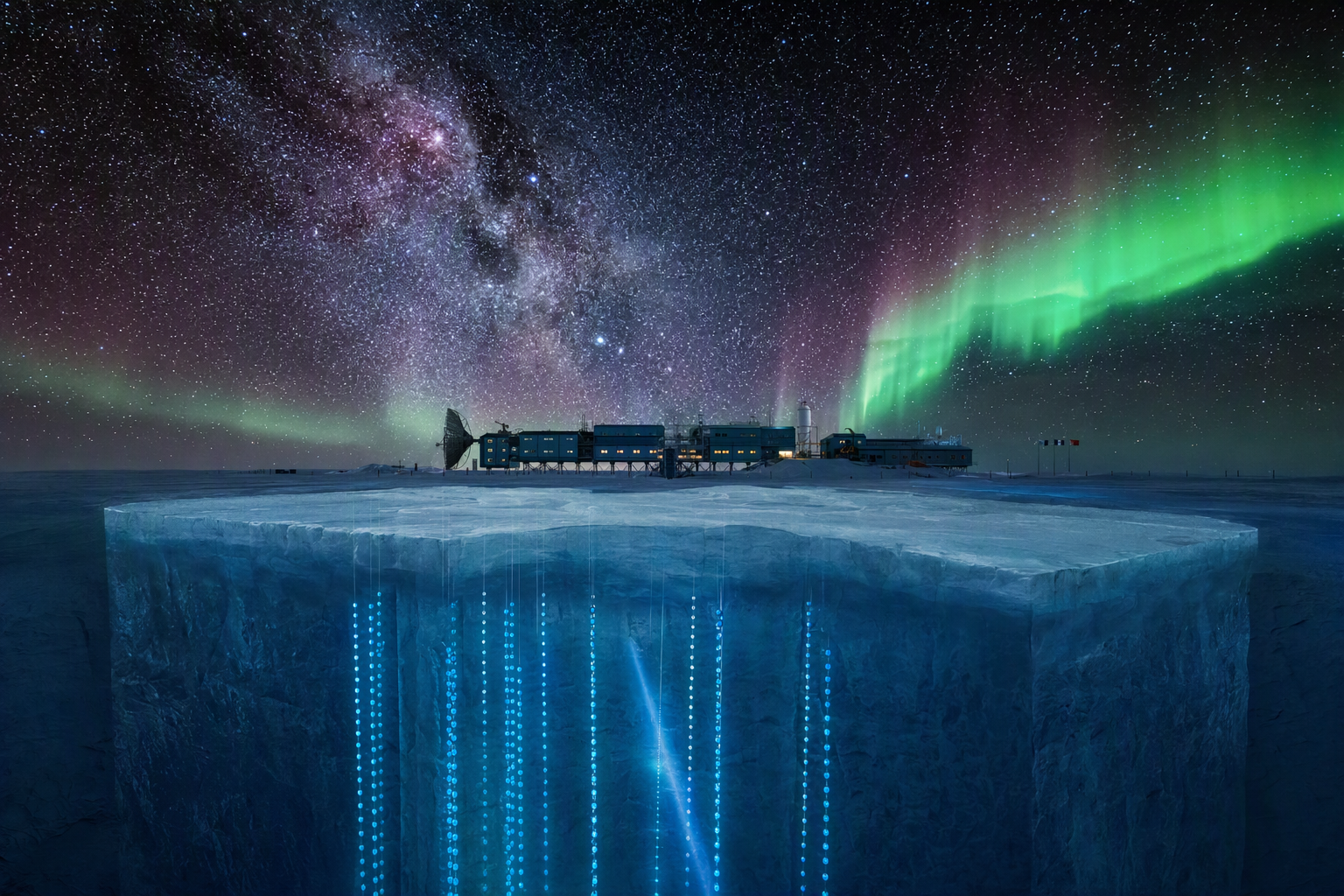
Enter the neutrino: an elusive subatomic particle so shy that trillions pass through your body every second without leaving a trace. Capturing these energetic “ghost particles” required an audacious, nearly unbelievable idea—transforming a cubic kilometer of ancient, crystal-clear glacial ice at the South Pole into a massive deep-space telescope.
The Announcement
On October 6, 2026, the Royal Swedish Academy of Sciences officially recognized the realization of this impossible dream. The 2026 Nobel Prize in Physics was awarded solely to Belgian-born theoretical physicist Francis Halzen for his decisive contributions to the IceCube Neutrino Observatory and the groundbreaking discovery of high-energy neutrinos originating from distant astrophysical sources.
As the long-standing Principal Investigator of the IceCube project, Halzen spearheaded an international collaboration that turned deep polar ice into an unparalleled window onto the high-energy universe. His work proved that the ghost particles physics community had spent decades chasing could serve as clean, unobstructed guides to the most violent events in space.
The scientific community celebrated Francis Halzen’s Nobel Prize win as a historic milestone that firmly cements multi-messenger astrophysics as a vital pillar of modern space exploration.
💡 Quick Answer
Who won the Nobel Prize in Physics in 2026, and why?
The 2026 Nobel Prize in Physics was awarded to Francis Halzen (University of Wisconsin–Madison) for leading the creation of the IceCube Neutrino Observatory at the South Pole and discovering high-energy cosmic neutrinos. Recognized as the flagship victory for ghost particles physics, the Francis Halzen Nobel Prize honors the first successful detection of a diffuse flux of high-energy astrophysical neutrinos, proving that a single physicist’s bold vision could unlock an entirely new era of multi-messenger astronomy.
- Laureate: Francis Halzen (University of Wisconsin–Madison)
- Key Facility: IceCube Neutrino Observatory (Amundsen-Scott South Pole Station, Antarctica)
- Primary Discovery: Detection of high-energy cosmic neutrinos extending to petaelectronvolt (PeV) energies originating from extragalactic sources
- 2026 Winner Status: Sole laureate in Physics
Who is Francis Halzen? The Visionary Behind IceCube
Growing up in Belgium, Francis Halzen was naturally drawn to the fast-paced evolution of particle physics during the 1960s. He completed his PhD at KU Leuven in 1969 before eventually moving to the United States to build a long-standing career as a professor at the University of Wisconsin–Madison. Early in his career, his work centered predominantly on traditional particle physics and massive quark-based structures. However, his scientific curiosity soon expanded outward, bridging the gap between what subatomic particles could teach us about the cosmos and how astrophysics could benefit from particle physics. Recognized widely for his academic achievements and honored with the UW Madison physics Nobel distinction, Halzen reshaped how researchers view the universe.

From Theoretical Physics to Building a Telescope Out of Ice
For a theoretician like Halzen, making the jump from blackboard calculations to building a physical telescope inside an extreme polar environment was a radical pivot. When studying how ultra-high-energy cosmic rays produce high-energy neutrinos, he realized that standard detectors on Earth were far too small to catch these rare, elusive particles. Inspired by concepts of using natural water or ice to capture Cherenkov light flashes, Halzen partnered with colleague John G. Learned to propose an unprecedented solution: burying a detector deep within the glacial ice sheets of the Antarctic. Rather than remaining solely in a theoretical domain, this bold Francis Halzen discovery framework turned a massive block of polar ice into a functional, kilometer-scale particle detector.
Unifying an International Collaboration Around an “Impossible Idea”
Turning a block of glacial ice into a deep-space observatory sounded like an impossible dream to many at first. Yet, Halzen’s relentless enthusiasm and scientific leadership acted as a vital catalyst. Serving as the driving force and IceCube collaboration principal investigator, he united engineers, glaciologists, and international researchers to overcome massive logistical hurdles—from pioneering hot-water drilling techniques deep into the ice cap to developing reverse-acting “lightbulbs” (optical modules) capable of surviving extreme conditions. Through decades of committed leadership, Francis Halzen transformed an unconventional concept into a thriving global collaboration that permanently redefined modern astrophysics.
What is the IceCube Neutrino Observatory?
Location and Scale: A Deep-Ice Cosmic Detector
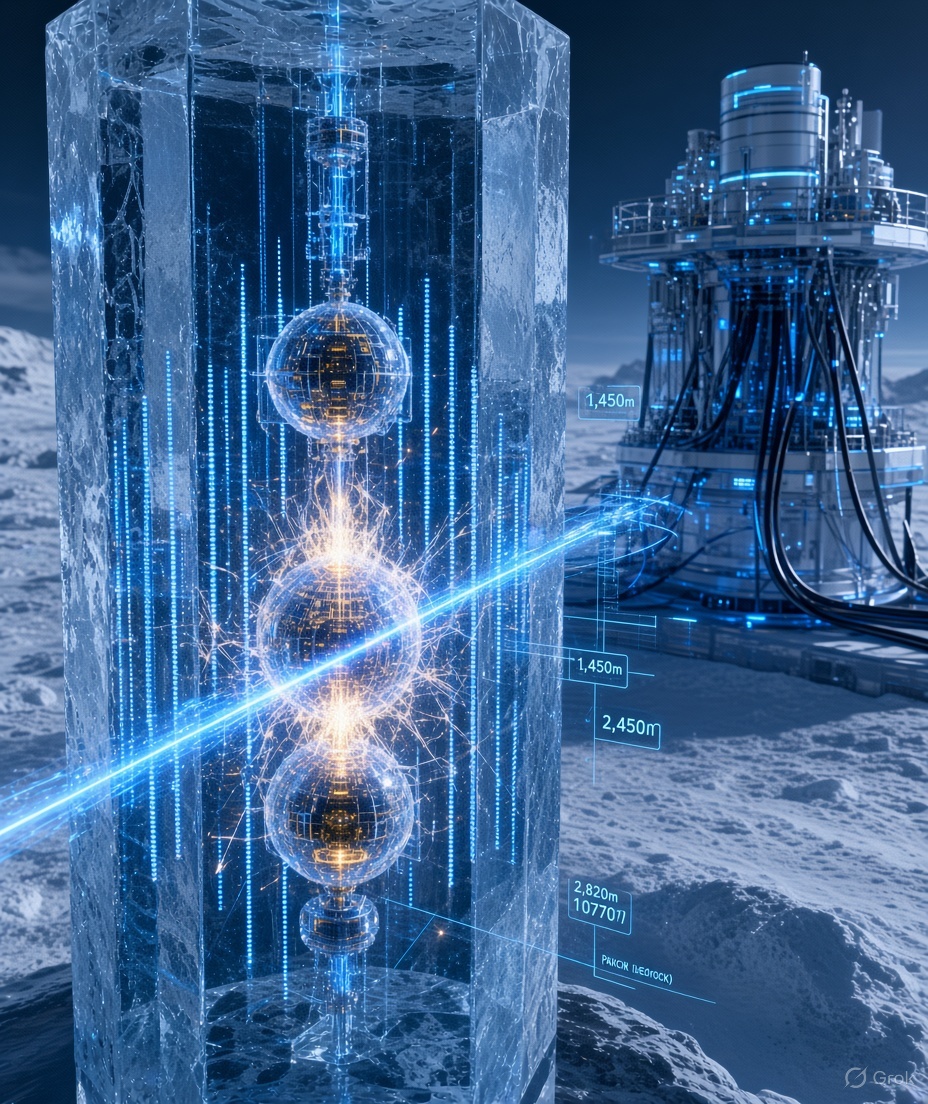
Far from traditional observatories perched on mountain peaks, the IceCube Neutrino Observatory is a monumental particle detector encased in the frozen depths of the Antarctic ice sheet near the Amundsen-Scott South Pole Station. Functioning as a massive 1 cubic kilometer ice telescope, the facility is buried between 1,450 meters and 2,450 meters beneath the surface. It consists of 5,160 optical sensors deployed along 86 vertical cables frozen into holes melted deep into the exceptionally pure and transparent polar ice cap.
How It Works: Catching Flashes in the Ice
Operating as an advanced South Pole neutrino detector, IceCube relies on an ingenious method to spot particles that normally pass right through matter. While most neutrinos pass straight through the detector without interacting, a rare few collide with atomic nuclei in or near the ice. These deep inelastic scattering events produce charged secondary particles that travel faster than the speed of light in a dielectric medium, generating a faint cone of blue UV-dominated radiation known as Cherenkov light. The facility’s downward-facing Cherenkov light sensors ice modules capture these optical flashes, allowing researchers to measure relative arrival times and photon counts to precisely reconstruct the energy and trajectory of the incoming neutrino.
Why Neutrinos Matter: Unobstructed Messengers from Deep Space
Unlike protons and other charged cosmic rays that are deflected by magnetic fields across the cosmos—or gamma-rays that get absorbed or scattered by cosmic dust and background radiation—neutrinos carry zero electric charge and interact only via gravity and the weak nuclear force. This unique property means neutrinos can travel straight across the universe unhindered, providing scientists with an unobstructed, direct window into violent cosmic phenomena such as active galactic nuclei and supermassive black holes.
Breakthrough Discovery: High-Energy Astrophysical Neutrinos
The Discovery: Tracing Signals Far Beyond Our Solar System
For years, detecting neutrinos meant capturing low-energy particles originating from our Sun or local radioactive decay. However, the historic astrophysical neutrinos discovery arrived when the IceCube collaboration confirmed the detection of ultra-high-energy particles originating far outside our solar system. By analyzing years of deep-ice data, researchers identified petaelectronvolt-scale events that completely ruled out a purely atmospheric explanation. This confirmed that high energy cosmic neutrinos could be successfully captured and isolated from background atmospheric noise, validating decades of theoretical prediction.
Cosmic Sources: Unmasking Active Galactic Nuclei and NGC 1068
With a reliable stream of data secured, scientists began mapping these high-energy tracks back to their celestial origins. A major breakthrough came from identifying potential candidate sources, such as the active galaxy NGC 1068 (M77), where numerous high-energy neutrinos were found clustered along its direction. Pinpointing an active galactic nuclei neutrino source allows researchers to probe the extreme environments surrounding supermassive black holes—regions where matter is violently accreted and accelerated particles collide to spawn both gamma rays and neutrinos.
Multi-Messenger Astronomy: A New Era of Astrophysics
The confirmation of cosmic neutrinos successfully birthed the era of multi-messenger astronomy. By combining neutrino telescope data with traditional optical observations, high-energy gamma-ray monitoring (such as data from the Fermi space telescope), and gravitational wave detectors, astrophysicists can cross-reference cosmic events. This unified approach allows humanity to study the universe’s most violent particle accelerators from multiple angles simultaneously, providing a complete picture that no single branch of science could achieve on its own.
Future Outlook: The Next Generation (IceCube-Gen2)
The Upcoming Expansion: Scaling Up to Eight Cubic Kilometers
Building on more than a decade of groundbreaking discoveries and the completion of vital system enhancements like the IceCube Upgrade, the scientific community is already looking toward the horizon. Plans are officially underway for the IceCube-Gen2 expansion, an ambitious next-generation facility that will dramatically scale up the instrumented volume to an astounding 8 cubic kilometers of glacial ice. This massive footprint will vastly increase the rate of neutrino captures, allowing researchers to spot rare, ultra-high-energy events with unprecedented precision.
Shaping the Future of Space Exploration and Particle Physics
This next generation South Pole telescope setup is set to redefine the future of neutrino astrophysics by shifting neutrino astronomy from a discovery phase into high-precision mapping. By capturing a much larger volume of high-energy cosmic particles, scientists will be able to accelerate their cosmic ray origin search, finally untangling how active galactic nuclei, supermassive black holes, and cataclysmic stellar explosions propel particles to energies far exceeding anything achievable in human-made colliders. Ultimately, IceCube-Gen2 will cement multi-messenger astronomy as a cornerstone of modern physics, opening unprecedented windows into the darkest, most violent mysteries of our universe.
🌌 Explore More: Discoveries Beyond Our Universe
From elusive particles arriving from deep space to technologies inspired by the human brain, science continues to challenge what we know about the universe and ourselves. If you enjoyed learning about Francis Halzen’s groundbreaking work in neutrino astronomy, explore these related articles for more fascinating discoveries in science and technology.
👉 The Human Connectome 2.0: Mapping Every Synapse in the Brain — Discover how scientists are mapping the brain’s complex neural connections to better understand how it works.
👉 AI Dream Interpretation — Explore how artificial intelligence could help researchers interpret patterns of neural activity during sleep.
👉 Memristors: Evolution, Applications & Neuromorphic Computing — Learn how brain-inspired electronic components could transform computing and artificial intelligence.
👉 Organoid Intelligence — Discover how lab-grown neural networks are opening new possibilities in biological computing.
👉 Neurograins — Find out how miniature wireless sensors could help scientists study brain activity in greater detail.
👉 Brain-Computer Interface (BCI) — Explore the remarkable technology connecting human brain signals with computers and external devices.
Keep exploring the frontiers of discovery! Visit Evolution of the Progress for more articles on groundbreaking scientific research, revolutionary inventions, and technologies that could shape our future.
FAQ
1. Who won the 2026 Nobel Prize in Physics?
The 2026 Nobel Prize in Physics was awarded solely to Francis Halzen, a professor at the University of Wisconsin–Madison, for his decisive contributions to the IceCube Neutrino Observatory and the discovery of high-energy cosmic neutrinos.
2. What is the IceCube Neutrino Observatory?
IceCube is a massive particle detector built into a cubic kilometer of pure glacial ice between 1,450 and 2,450 meters deep at the Amundsen-Scott South Pole Station in Antarctica. It uses over 5,000 optical sensors to capture faint flashes of Cherenkov light produced when high-energy cosmic neutrinos collide with atomic nuclei.
Neutrinos are nicknamed ghost particles because they carry zero electric charge, have almost no mass, and pass through solid matter—including planets and human bodies—almost entirely unhindered and unnoticed.
4. How do neutrinos help us understand the universe?
Unlike protons and other charged cosmic rays that get deflected by space magnetic fields, or gamma-rays that get absorbed by cosmic dust, neutrinos travel straight from violent cosmic phenomena (like supermassive black holes and active galactic nuclei) without bending or scattering. This allows scientists to use them as clean guides to map the universe's most extreme particle accelerators.
5. What is the next phase for the project?
The collaboration is currently planning IceCube-Gen2, an ambitious expansion that will scale the instrumented volume up to 8 cubic kilometers of Antarctic ice, dramatically increasing the rate of high-energy neutrino detections.